NEAT-POCKET: Pocket-Conditioned Autoregressive 3D Molecular Generation with a Neighborhood-Guided Set Transformer
한 줄 요약: NEAT-POCKET의 핵심은 pocket-conditioned 3D generation을 수백 번의 전역 denoising으로 풀지 않고, 현재까지 만들어진 unordered atom set에서 다음 원자의 type과 3D 위치를 한 번씩 결정하는 autoregressive outer loop로 바꾸면서, pocket은 fine→coarse→fine transformer와 cross-attention/AdaLN으로 조건화하고 fragment prefix는 초기 state로 그대로 넣어 lead-optimization형 completion을 자연스럽게 지원한다는 것입니다.
왜 이 논문을 저장하는가
Pocket-conditioned molecular generation은 최근 diffusion과 flow 계열이 지배적입니다. 이들은 강한 geometric inductive bias와 parallel state refinement라는 장점이 있지만, 한 molecule을 만들기 위해 같은 비싼 network를 여러 noise/time step에서 반복 평가합니다.
추상적으로 iterative generator의 비용을
라고 두면, 이 수십~수백이고 매 step마다 ligand와 pocket 전체를 다시 처리할 때 sampling latency가 커집니다.
NEAT-POCKET은 질문을 바꿉니다.
분자를 한 번에 계속 정제하지 말고, pocket을 보면서 원자를 하나씩 추가하면 어떨까?
이때 단순한 canonical-order autoregressive model로 돌아가지 않는 것이 중요합니다. Base NEAT의 핵심은 현재 molecule을 ordered sequence가 아니라 set으로 다루고, 임의 source set에서 그 1-hop neighborhood를 target으로 예측하는 neighborhood-guided training입니다. 따라서 generation order 자체가 molecular identity의 일부가 되지 않도록 설계합니다.
그리고 한 가지 더 중요한 nuance가 있습니다.
NEAT-POCKET은 “flow를 버린 autoregressive model”이 아닙니다.
Outer generation loop는 atom-by-atom autoregressive이지만, 새 원자의 3D coordinate를 놓는 local head는 continuous Flow Matching입니다. 즉 이 논문의 진짜 비교 축은
입니다.
이 분해는 SBDD generative model을 설계할 때 매우 재사용 가능한 architecture choice입니다.
Metadata
| Field | Value |
|---|---|
| Paper | NEAT-POCKET: Pocket-Conditioned Autoregressive 3D Molecular Generation with a Neighborhood-Guided Set Transformer |
| Authors | Roxane Axel Jacob, Daniel Rose, Thierry Langer, Johannes Kirchmair |
| arXiv | 2609.05097 |
| Version | v1 |
| Submitted | 2026-09-04 |
| Base model | NEAT |
| Generation family | Set-based autoregressive outer loop + Flow Matching coordinate head |
| Main datasets | CrossDocked, SPINDR |
| Official implementation | molinfo-vienna/NEAT-POCKET |
| Reviewed code snapshot | 323f262 |
| Released weights | Figshare 10.6084/m9.figshare.33426877 |
| Code license | MIT |
| Main practical capability | de novo pocket generation + fragment/prefix completion |
Claim boundary: 아래 benchmark 수치와 qualitative conclusions는 논문 저자들이 보고한 결과입니다. PoseBusters validity, protein–ligand clash count, strain energy, docking score, molecular size, sampling time, 그리고 실제 binding/activity는 서로 다른 evidence layer이며 하나의 “drug quality” 점수로 합치지 않습니다.
Figure guide — 먼저 이 두 장을 보자
Official overview — architecture와 generation loop
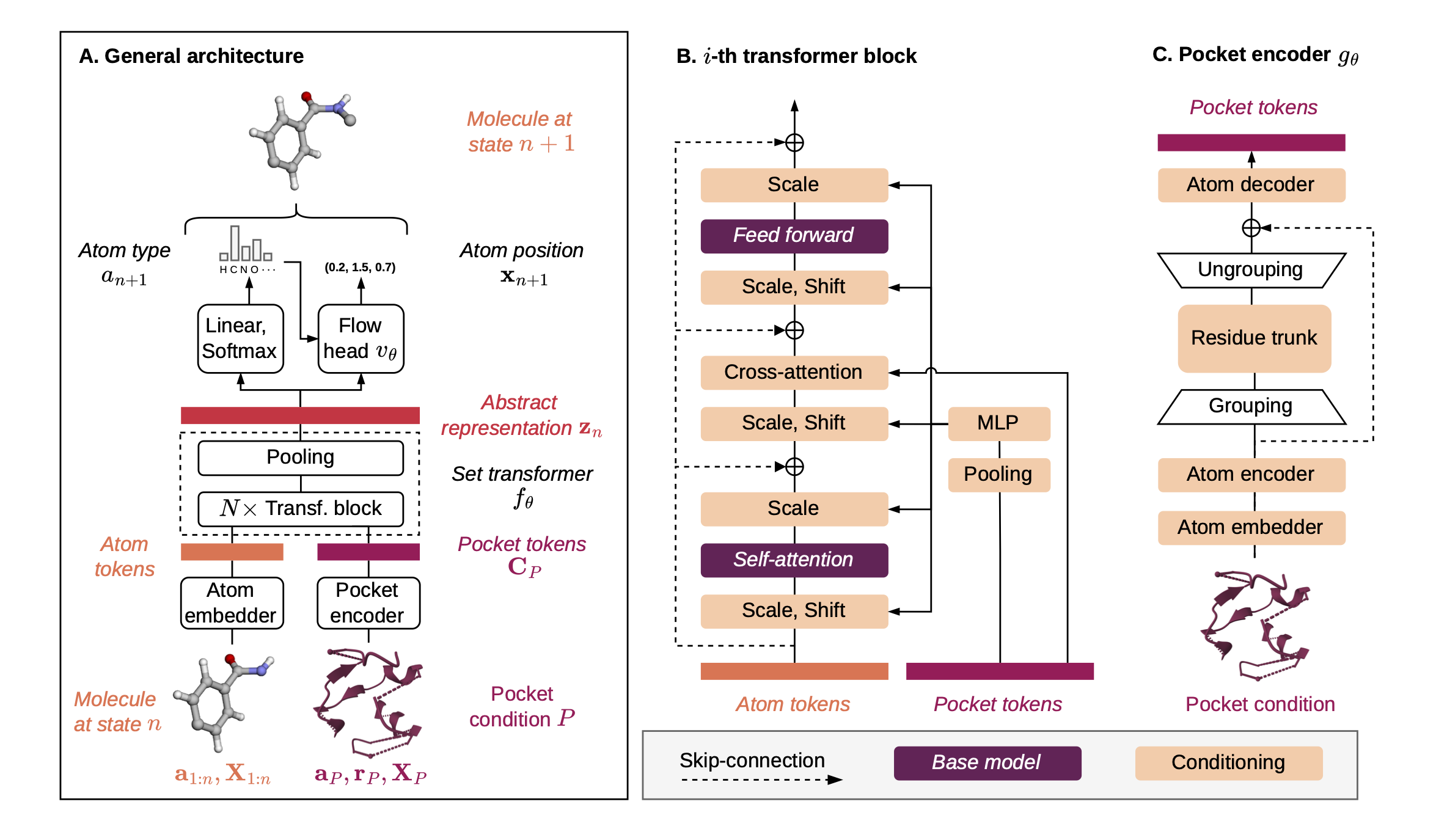
Source: official NEAT-POCKET repository, images/overview.png, commit 323f262, MIT-licensed repository. 이 그림은 저자 제공 architecture visualization이며 독립 검증 결과가 아닙니다.

볼 것: ligand를 한꺼번에 denoise하는 것이 아니라 현재 molecular set을 context로 다음 atom을 추가하고, pocket representation이 ligand stream에 conditioning으로 들어가는 흐름입니다. 이 그림을 읽을 때 가장 중요한 것은 “autoregressive”와 “3D flow”가 상호 배타적이지 않다는 점입니다.
Official prefix artifact — fragment completion의 입력 contract
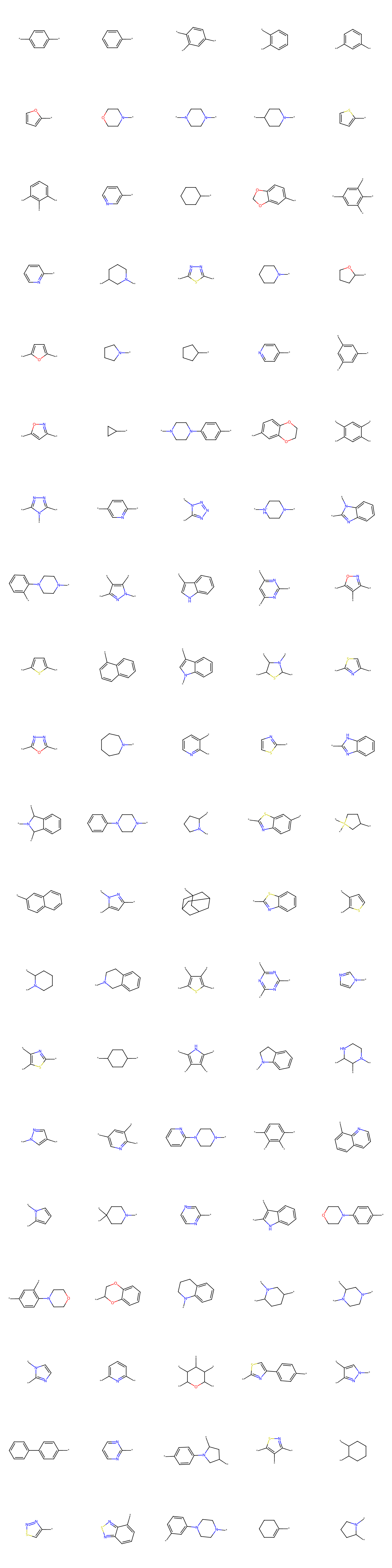
Source: official NEAT-POCKET repository, prefixes/prefixes.png and paired prefixes/prefixes.sdf, commit 323f262. 이 이미지는 released fragment/prefix artifact를 보여주는 공식 repository visualization입니다.
볼 것: prefix-conditioned generation은 별도의 mask/inpainting trajectory를 정의하는 대신, 이미 주어진 fragment를 현재 source set으로 넣고 그 뒤 atom을 계속 추가하는 interface입니다. 이 때문에 prefix identity와 coordinates를 “다시 생성해서 맞추는” 문제가 아니라 초기 condition으로 보존하는 문제가 됩니다.
1. Problem: 3D molecular generation의 비용은 어디서 생기는가
Pocket-conditioned generation의 목표는 보통 다음과 같이 적을 수 있습니다.
where
- : target protein pocket,
- : atom types, coordinates, connectivity를 포함하는 generated ligand입니다.
Diffusion/flow 계열에서는 보통 noisy full-ligand state 를 여러 번 업데이트합니다.
각 step에서 전체 ligand state와 pocket interaction을 다시 계산하므로 inference cost는 number of function evaluations와 강하게 연결됩니다.
반대로 autoregressive factorization은
처럼 생각할 수 있습니다.
여기서
- : 지금까지 생성된 atom set,
- : 다음 atom type,
- : 다음 atom coordinate입니다.
단순히 보면 atom 수만큼 순차 step이 필요하기 때문에 autoregression도 “공짜”는 아닙니다. 하지만 한 step에서 다루는 task가 전체 molecule 재정제가 아니라 새 atom 하나의 local decision으로 바뀝니다.
따라서 비교해야 할 것은 단순 step count가 아니라
입니다.
NEAT-POCKET의 가장 강한 empirical claim은 바로 이 축입니다.
2. Base NEAT의 핵심: sequence가 아니라 set을 autoregress한다
일반적인 autoregressive molecular model은 atom ordering을 하나 정합니다.
atom 1 → atom 2 → atom 3 → ...그러면 동일한 molecule도 atom indexing이나 traversal rule에 따라 다른 sequence가 될 수 있습니다. 이것은 molecule이 본질적으로 permutation-invariant object라는 사실과 충돌합니다.
NEAT의 training contract는 다릅니다.
현재 molecule의 atom subset을 source set 라고 하고, target을 source set의 one-hop molecular neighborhood로 둡니다.
Official implementation에서도 forward pass가 molecular data를 source atom set과 target atom set으로 나누고, target set을 source의 1-hop neighborhood로 정의합니다.
이렇게 하면 model이 학습하는 질문은
“다음 index가 무엇인가?”
가 아니라
“현재 존재하는 이 atom set의 chemically local frontier에 무엇이 추가되어야 하는가?”
가 됩니다.
이 차이가 Neighborhood-Guided Set Transformer라는 이름의 핵심입니다.
왜 이것이 중요한가
Permutation invariance는 단순 미학적 성질이 아닙니다.
- 특정 canonical order에 과도하게 의존하지 않습니다.
- arbitrary molecular fragment를 source set으로 사용할 수 있습니다.
- fragment completion을 별도 architecture로 만들 필요가 줄어듭니다.
- source set의 크기가 0부터 full molecule까지 바뀌는 training task가 자연스럽습니다.
즉 generation order를 representation contract에서 제거합니다.
3. 한 step에서 실제로 무엇을 예측하는가
한 autoregressive step은 크게 두 문제입니다.
3.1 Atom type
현재 set representation 에서 다음 atom class를 예측합니다.
STOP token도 같은 decision family 안에 들어갑니다.
3.2 Coordinate
새 atom의 coordinate는 단순 regression으로 찍지 않습니다.
Official implementation은 SimpleMLPAdaLN 기반의 Flow Matching head를 사용합니다. 즉 random/noisy position에서 target coordinate로 가는 local velocity field를 학습합니다.
추상적으로
중요한 점은 가 새로 추가될 target atom의 위치라는 것입니다.
그래서 NEAT-POCKET의 계산 구조는 다음처럼 볼 수 있습니다.
current atom set S_k
    ↓ set transformer + pocket conditioning
next atom type
    ↓
local coordinate flow
    ↓
add one atom to set
    ↓
S_{k+1}
전역 3D state에 대한 수백-step trajectory 대신 짧은 local coordinate-generation problem을 atom addition마다 푸는 구조입니다.
4. Pocket encoder: fine → coarse → fine
Pocket atom을 모두 flat token으로 넣으면 local atomic detail은 잘 보이지만 long-range context 비용이 커집니다. 반대로 residue token만 쓰면 atom-level steric detail을 잃을 수 있습니다.
NEAT-POCKET은 pocket을 세 단계로 처리합니다.
Stage A — atom-level pocket transformer
Pocket atom type과 Cartesian coordinates를 embedding하고 atom-level self-attention을 수행합니다.
Stage B — atom → residue pooling + residue transformer
같은 residue에 속한 atom representation을 pool합니다. Reviewed official training config의 default는 sum pooling입니다.
그 뒤 residue-level transformer가 coarse context를 교환합니다.
Stage C — residue information을 다시 atom resolution으로
Residue-level context를 다시 atom stream과 결합한 뒤 두 번째 atom-level pocket transformer를 적용합니다.
따라서 pocket representation은
입니다.
이 구조는 pocket에서 필요한 두 종류의 정보가 다르다는 가정을 담습니다.
- atom level: clash, local chemistry, precise geometry
- residue level: broader pocket context, interaction environment
이 fine–coarse–fine contract는 pocket model 자체로도 재사용 가치가 있습니다.
5. Pocket과 ligand는 어떻게 만나는가
Pocket representation을 얻은 다음 ligand stream에 두 경로로 조건을 제공합니다.
5.1 Cross-attention
Ligand source-set token이 pocket atom representation을 직접 참조할 수 있습니다.
이를 통해 “현재 fragment/partial molecule의 이 부분에서 pocket의 어떤 부분을 봐야 하는가?”를 local하게 결정할 수 있습니다.
5.2 Global adaptive normalization
Pocket representation을 graph-level로 pool해 global condition 를 만들고, ligand transformer / coordinate head의 normalization을 조절합니다.
개념적으로
Official training config에서는 global_cond_proj: true를 사용합니다.
5.3 Zero initialization
새 conditioning branch를 pretrained unconditional NEAT에 붙일 때 cross-attention projection과 adaptive-conditioning projection의 마지막 layer를 zero-init합니다.
초기에는
이 되도록 만들어 pocket condition이 학습 시작부터 pretrained molecular prior를 강하게 깨뜨리지 않게 합니다.
이것은 conditional fine-tuning에서 매우 일반적으로 재사용 가능한 design pattern입니다.
6. Pretraining → pocket conditioning
Released training config는 pretrained unconditional NEAT를 사용합니다.
공식 config의 주요 값은 다음과 같습니다.
| Parameter | Released SPINDR config |
|---|---|
| Transformer width | 768 |
| Ligand transformer layers | 12 |
| Attention heads | 12 |
| Flow-head width | 1536 |
| Flow-head residual blocks | 6 |
| Residue-level pocket layers | 4 |
| Atom-level pocket layers | 1 before + 1 after residue stage |
| Batch size | 128 |
| Learning rate | |
| Max epochs | 5000 |
| CFG dropout | 0.2 |
| Clash penalty weight | 4.0 |
| Freeze pretrained model | yes initially |
| Unfreeze epoch | 150 |
| Flow noise std | 2.5 |
| Time-step resampling | 4 |
Official code는 matching pretrained parameters를 conditional model로 옮긴 뒤, 설정에 따라 pretrained branch를 먼저 freeze하고 새 pocket-conditioning layers를 학습할 수 있게 합니다.
이 training schedule의 의도는 명확합니다.
7. Clash penalty는 무엇을 학습시키는가
Pocket-conditioned generator가 좋은 molecular distribution을 배웠다고 해서 protein volume을 자동으로 피하는 것은 아닙니다.
NEAT-POCKET은 explicit protein–ligand clash penalty를 추가합니다.
일반적으로 atom pair distance 가 허용 거리보다 작을 때 penalty를 주는 형태로 생각할 수 있습니다.
where 는 너무 가까운 pair에 대해 증가합니다.
전체 objective는 개념적으로
Official implementation의 forward path도 atom-type CE, flow-matching loss, optional clash penalty를 합칩니다.
이 항의 역할은 docking affinity를 최적화하는 것이 아닙니다.
Pocket condition을 “protein과 충돌하지 않는 geometry”라는 최소 geometric constraint로 연결하는 것입니다.
따라서 clash 감소를 binding 개선으로 해석하면 안 됩니다.
8. Classifier-Free Guidance: condition을 강하게 하면 항상 좋아지는가?
아닙니다. 이 논문의 중요한 negative result 중 하나입니다.
Training에서는 일정 확률로 pocket condition을 drop하여 conditional/unconditional branch를 함께 학습하고, sampling에서는 classifier-free guidance로 pocket conditioning strength를 조절합니다.
추상적으로
가 커지면 pocket preference가 강해질 수 있지만, molecular prior를 과도하게 밀어낼 수도 있습니다.
CrossDocked에서 저자 보고 pattern은 다음과 같습니다.
| CFG factor | PB valid ↑ | clashes ↓ | strain ↓ | Vina ↓ | MW |
|---|---|---|---|---|---|
| 0.0 | 71.0 | 8.3 | 155 | -4.4 | 273 |
| 0.5 | 69.2 | 6.6 | 265 | -5.1 | 289 |
| 1.0 | 64.1 | 5.8 | 382 | -5.3 | 300 |
| 1.5 | 58.4 | 5.1 | 511 | -5.5 | 308 |
| 2.0 | 53.5 | 4.7 | 544 | -5.6 | 316 |
| 2.5 | 47.9 | 4.5 | 783 | -5.6 | 323 |
해석은 단순합니다.
- stronger conditioning → clash 감소
- raw Vina score는 좋아짐
- molecule size 증가
- PoseBusters validity 하락
- strain 급증
즉
특히 Vina는 ligand size와 강하게 연결되므로 가 커질수록 Vina가 좋아지는 것을 순수한 pocket complementarity 개선으로 읽으면 안 됩니다.
이 paper가 보여주는 것은 controllability–physical-plausibility frontier입니다.
9. Benchmark contract: CrossDocked와 SPINDR를 같은 의미로 읽으면 안 된다
CrossDocked
CrossDocked는 historical comparability가 좋지만 rigid cross-docking 때문에 reference complex 자체에 비현실적 geometry가 포함될 수 있습니다.
논문이 평가한 reference ligand도 100% PoseBusters-valid하지 않습니다. 따라서 model-generated structure의 absolute quality를 판단할 때 benchmark ceiling 자체가 깨끗하지 않습니다.
또 원래 CrossDocked ligand에는 hydrogen annotation이 거의 없어, NEAT-POCKET은 explicit-hydrogen model과 consistent evaluation을 위해 preprocessing에서 hydrogens를 복원합니다.
SPINDR
SPINDR는 PLINDER 기반으로 더 엄격한 filtering과 protein preparation을 적용한 high-quality complex set입니다.
이 benchmark를 포함한 것은 이 논문의 장점입니다. 단순히 CrossDocked leaderboard 하나에서만 model을 평가하지 않습니다.
하지만 SPINDR도 retrospective computational benchmark입니다.
따라서 다음 claim은 아직 별개입니다.
10. Main result: speed는 강하고, quality는 trade-off다
CrossDocked
저자 보고 핵심 비교는 다음과 같습니다.
| Model | PB valid ↑ | clashes ↓ | strain ↓ | Vina ↓ | Vina-min ↓ | MW | 100 mol runtime ↓ |
|---|---|---|---|---|---|---|---|
| Pocket2Mol | 71.1 | 6.9 | 65 | -5.4 | -6.9 | 223 | 845 s |
| TargetDiff | 46.4 | 10.8 | 1003 | -6.5 | -7.5 | 324 | 722 s |
| DiffSBDD | 49.6 | 14.3 | 891 | -3.6 | -6.3 | 296 | 88 s |
| DrugFlow | 61.7 | 9.2 | 255 | -5.8 | -6.9 | 309 | 112 s |
| NEAT-POCKET | 69.2 | 6.6 | 265 | -5.1 | -6.6 | 289 | 4 s |
이 표에서 정직한 결론은 “NEAT-POCKET이 best generator”가 아닙니다.
- PB validity는 강합니다.
- clash count는 낮습니다.
- sampling speed는 매우 강합니다.
- strain은 Pocket2Mol보다 나쁩니다.
- docking score는 TargetDiff/DrugFlow보다 약합니다.
- generated molecular size가 모델마다 다릅니다.
즉 가장 강한 claim은
competitive geometric quality를 유지하면서 sampling latency를 크게 줄였다
입니다.
SPINDR
SPINDR에서는 비교 가능한 FLOWR와 다음 trade-off가 보고됩니다.
| Model | PB valid ↑ | clashes ↓ | strain ↓ | Vina ↓ | Vina-min ↓ | MW | runtime ↓ |
|---|---|---|---|---|---|---|---|
| FLOWR | 75.8 | 4.6 | 35 | -7.0 | -7.7 | 395 | 36 s |
| NEAT-POCKET | 80.3 | 3.7 | 62 | -5.5 | -6.8 | 307 | 4 s |
여기서도 same story입니다.
- validity / clashes / speed → NEAT-POCKET 우위
- strain / docking → FLOWR 우위
- FLOWR molecule이 훨씬 큼
따라서 docking score만으로 architecture ranking을 하면 size confound가 큽니다.
11. Molecular-size confound를 반드시 따로 봐야 한다
Vina-like docking score는 대체로 더 많은 contact를 만들 수 있는 큰 molecule에 유리해질 수 있습니다.
그래서
이고 단순히 score가 더 낮다고 해서 normalized binding quality가 높다는 뜻은 아닙니다.
NEAT-POCKET은 CrossDocked에서 평균 MW 약 289 Da, SPINDR에서 약 307 Da의 비교적 작은 molecule을 생성합니다.
이는 두 방향으로 작용합니다.
장점
- early hit처럼 optimization headroom이 남을 수 있음
- steric clash가 줄기 쉬움
- fragment growth에 적합할 수 있음
단점 / confound
- raw Vina가 불리할 수 있음
- “good pocket filling”과 “small ligand”가 섞일 수 있음
따라서 fair evaluation에는 최소한 다음을 같이 봐야 합니다.
- heavy-atom count / MW
- ligand efficiency-like normalized score
- pocket occupancy
- clash count
- strain
- pose validity
12. Fragment completion이 왜 architecture-level 장점인가
이 논문에서 가장 실용적으로 흥미로운 부분은 de novo generation보다 fragment completion일 수 있습니다.
Diffusion inpainting에서는 보통 prefix atom을 trajectory 중 고정하거나, 매 step reference position으로 re-project하거나, mask-specific dynamics를 설계해야 합니다.
NEAT-POCKET에서는 fragment 를 그냥 initial source set으로 둡니다.
그 뒤
즉 기존 fragment를 다시 생성하지 않습니다.
따라서 prefix preservation은 soft objective가 아니라 construction rule에 가깝습니다.
이미 존재하는 원자를 건드리지 않고 frontier만 성장시킨다.
Lead optimization / scaffold elaboration과 interface가 잘 맞는 이유입니다.
13. Fragment size가 커질수록 무슨 일이 생기는가
저자들의 prefix experiments는 intuitive한 trade-off를 보여줍니다.
CrossDocked에서 large prefix를 주면 de novo보다:
- PB validity: 약 69.2% → 81.8%
- strain: 약 265 → 78 kcal/mol
- Vina: 약 -5.1 → -6.1 kcal/mol
SPINDR에서는:
- PB validity: 약 80.3% → 88.8%
- strain: 약 62 → 25 kcal/mol
- Vina: 약 -5.5 → -7.0 kcal/mol
즉 더 많은 chemically valid structure를 고정해 주면 completion problem이 쉬워집니다.
하지만 diversity cost가 생깁니다.
- CrossDocked uniqueness: 약 92.8% → 42.4%
- SPINDR uniqueness: 약 97.6% → 52.2%
이것은 실패라기보다 조건부 generation의 본질적인 trade-off입니다.
따라서 fragment completion benchmark는 validity 하나만 보면 안 됩니다.
14. Prefix preservation은 별도 metric이어야 한다
Fragment-conditioned generation에서 아주 중요한 평가 질문은:
결과 molecule이 “그 fragment와 비슷한가?”가 아니라 정확히 그 fragment를 유지했는가?
입니다.
NEAT-POCKET은 construction상 prefix coordinates와 atom identity를 유지합니다.
반면 다른 generative method가 fragment conditioning을 지원하더라도 trajectory 중 fragment가 변형될 수 있습니다.
따라서 fragment benchmark에는 다음 metric이 필요합니다.
- exact atom/bond identity retention
- prefix RMSD
- attachment-point correctness
- completed molecule validity
- pocket clash
- strain
- docking
- uniqueness/diversity
- synthetic plausibility
특히 prefix retention filter 없이 전체 결과만 평균내면 “fragment-conditioned”라는 claim 자체가 약해질 수 있습니다.
15. Bond generation은 coordinate generation과 분리되어 있다
NEAT-POCKET은 atom type과 coordinates를 생성한 뒤 bond assignment를 별도 predictor/reconstruction stage에서 처리합니다.
이 design은 장점과 비용이 있습니다.
장점
3D coordinate generation problem을 bond-order combinatorics와 분리할 수 있습니다.
위험
좋은 point cloud가 항상 chemically correct graph로 변환되지는 않습니다.
즉 최종 validity는
의 합성 결과입니다.
따라서 failure analysis에서도 다음을 분리해야 합니다.
- atom type failure
- coordinate/steric failure
- bond assignment failure
- sanitization failure
“generation invalid” 하나로 합치면 architecture bottleneck을 찾기 어렵습니다.
16. 이 모델은 equivariant network가 아닌데 rotation 문제는 어떻게 다루는가
NEAT family는 전형적인 irreps-based SE(3) network를 backbone으로 사용하지 않습니다. Cartesian coordinate를 Fourier feature로 embedding한 transformer 계열입니다.
이 경우 중요한 질문은:
coordinate frame dependence를 어떻게 막는가?
입니다.
Official code에는 random rotation augmentation이 포함되어 있습니다.
즉 strict architectural equivariance 대신
으로 rotation robustness를 학습하는 방향입니다.
이것은 매우 중요한 비교 축입니다.
Strict equivariance의 장점
같은 transform law가 architecture에 내장됩니다.
Learned/augmented geometric behavior의 장점
- simpler/faster kernels 가능
- higher-order irreps overhead 없음
- 일반 transformer stack 재사용 가능
따라서 NEAT-POCKET의 속도 gain을 해석할 때 단순 “autoregression이 diffusion보다 빠르다”라고만 하면 불완전합니다.
Backbone symmetry implementation의 비용 차이도 포함될 수 있습니다.
17. 무엇이 실제 novelty인가
구성 요소를 따로 보면 완전히 처음인 것은 많지 않습니다.
Autoregressive molecule generation
기존에 존재합니다.
Set Transformer
기존 architecture family입니다.
Pocket cross-attention
다른 conditional molecular model에서도 볼 수 있습니다.
Flow Matching
coordinate generation objective 자체도 기존입니다.
Clash penalty / CFG
개별 기술은 알려져 있습니다.
진짜 기여
재사용 가능한 contribution은 이 조합에 있습니다.
특히 fragment completion을 별도 inpainting algorithm이 아니라 autoregressive state initialization으로 바꾼 것이 architecture–task alignment 측면에서 강합니다.
18. 이 논문이 잘 보여주는 것
18.1 Global iterative refinement가 유일한 3D generation route는 아니다
Competitive validity를 유지하면서 훨씬 낮은 sampling latency가 가능하다는 evidence를 제공합니다.
18.2 Geometric metric은 하나가 아니다
PoseBusters, clash, strain, docking이 서로 다른 방향으로 움직입니다.
18.3 Dataset quality가 model ranking을 바꾼다
CrossDocked와 SPINDR를 함께 보면 “좋은 generator”의 의미가 benchmark preprocessing에 강하게 의존한다는 점이 드러납니다.
18.4 Prefix completion은 autoregressive representation과 잘 맞는다
Fixed fragment를 trajectory constraint로 다루지 않고 state로 보존할 수 있습니다.
18.5 Conditioning strength에는 frontier가 있다
Strong CFG가 clash와 raw docking을 개선하면서 동시에 strain/validity를 망가뜨릴 수 있습니다.
19. 이 논문이 아직 증명하지 못한 것
19.1 Prospective biological activity
모든 주 evidence는 computational generation benchmark입니다.
19.2 Broad protein-family OOD
CrossDocked/SPINDR split에서 잘 작동하는 것과 unseen protein families에 일반화하는 것은 다릅니다.
필요한 것은 explicit:
- protein sequence/structure family split
- ligand scaffold split
- joint protein + scaffold OOD
- temporal structure split
입니다.
19.3 Apo pocket discovery
Released generation_from_pdb.py workflow는 현재 reference ligand가 pocket region을 정의하는 데 필요합니다. README는 ligand가 generation condition으로 직접 사용되지는 않는다고 명시하지만, known ligand location으로 pocket을 정한다는 사실 자체는 deployment information입니다.
따라서 이것은 global de novo pocket discovery model이 아닙니다.
19.4 Protein flexibility
Pocket은 기본적으로 static structure입니다.
- induced fit
- alternative side-chain conformations
- water network
- ensemble uncertainty
를 해결하지 않습니다.
19.5 Autoregressive error accumulation
앞 단계의 잘못된 atom addition이 뒤 단계 context가 됩니다.
Molecule이 커질수록 error propagation이 누적될 수 있습니다.
20. 가장 중요한 compute-matched ablation
이 architecture를 판단하려면 다음 비교가 가장 중요합니다.
| Arm | Generator | Pocket conditioning | Prefix support |
|---|---|---|---|
| A | iterative global flow | same pocket encoder | inpainting |
| B | autoregressive set + coordinate regression | same | native |
| C | autoregressive set + local flow | same | native |
| D | C + clash penalty | same | native |
| E | D + CFG | same | native |
모든 arm에서:
- training complexes
- pocket cutoff
- parameter budget
- generated molecule count
- GPU
- final bond reconstruction
- evaluation scripts
를 가능한 한 맞춰야 합니다.
Primary outputs
를 중심으로:
- PB validity
- protein–ligand clashes
- strain
- normalized docking
- MW / heavy atom count
- diversity / novelty
- exact prefix retention
- model calls / NFE
- peak memory
- throughput
를 같이 봐야 합니다.
21. Autoregressive vs diffusion/flow를 더 공정하게 비교하려면
“4초 vs 88초”는 강한 숫자지만 architecture science로는 다음 요소를 분리해야 합니다.
21.1 Backbone cost
Equivariant GNN/Transformer와 ordinary set transformer의 FLOPs 차이.
21.2 Number of updates
Global denoising NFE와 atom additions 수.
21.3 Batch parallelism
Autoregressive generation이 molecule 내부에서는 sequential이어도 여러 molecules를 batch로 병렬화할 수 있습니다. Released README는 RTX 4090에서 큰 generation batch도 가능하다고 설명합니다.
21.4 Bond post-processing
Generation runtime에 bond reconstruction / sanitization / evaluation이 어디까지 포함되는지 동일하게 맞춰야 합니다.
21.5 Molecule size
더 작은 molecule은 generation step 수 자체가 적습니다.
따라서 throughput은
뿐 아니라
로도 보는 것이 좋습니다.
22. Generalization test는 이렇게 강화할 수 있다
Protein-family OOD
Protein sequence identity나 pocket structure similarity로 cluster한 뒤 cluster-disjoint split.
Ligand scaffold OOD
Bemis–Murcko scaffold가 train/test를 넘지 않도록 split.
Joint OOD
Size-stratified evaluation
Ligand heavy-atom count별로 performance를 나눠 autoregressive error accumulation을 확인합니다.
Prefix difficulty axis
Prefix size뿐 아니라 attachment-point ambiguity와 3D exposure를 나눕니다.
예:
- buried prefix
- edge-exposed prefix
- multiple growth vectors
- constrained macrocyclic context
Pocket uncertainty
Same target의 multiple experimental conformations 또는 predicted-structure ensemble을 사용합니다.
23. Lead optimization 관점에서 가장 흥미로운 실험
Fragment completion의 진짜 utility는 단순 random BRICS prefix보다 medicinal-chemistry setting에서 확인해야 합니다.
예를 들면:
known fragment / lead core
    ↓
fixed interaction motif
    ↓
NEAT-POCKET growth
    ↓
pose/strain/clash filters
    ↓
novel substituent diversity
    ↓
rescoring / synthesis feasibility
여기서 중요한 metric은:
- core RMSD = 0에 가까운가
- key interaction 유지
- growth vector 다양성
- R-group novelty
- synthetic accessibility
- docking improvement normalized by added heavy atoms
- strain increase
- scaffold/analog diversity
입니다.
특히 “더 큰 molecule을 붙이면 docking score가 좋아진다”는 trivial solution을 막기 위해
같은 normalized view가 필요합니다.
24. Reproducibility path
Official repository는 재현성이 좋은 편입니다.
공개된 것
- training code
- generation code
- fragment-generation utility
- evaluation script
- bond predictor training
- CrossDocked/SPINDR dataset loaders
- pretrained / conditional weight download path
- released YAML configs
- PoseBusters and SBDD metric utilities
- official architecture image
- example protein/ligand/fragment input
권장 재현 순서
- Released weights를 받습니다.
- Official example
3R8G로generation_from_pdb.py가 돌아가는지 확인합니다. - 동일 RTX-class GPU에서 100-molecule runtime을 측정합니다.
- SPINDR released/default config로 PB validity / clashes를 재현합니다.
- CFG factor sweep를 재현합니다.
- BRICS prefix experiment를 실행합니다.
- Prefix identity/RMSD를 독립적으로 다시 검증합니다.
- 그 다음 OOD split을 추가합니다.
주의
README 기준으로 현재 arbitrary PDB generation은 reference ligand가 pocket extraction에 필요합니다. 이 조건을 “protein structure만으로 generation”이라고 축약해서는 안 됩니다.
25. Failure modes
| Failure mode | 왜 위험한가 |
|---|---|
| 4 s runtime만 보고 superior generator라 결론 | quality/size/backbone cost가 다름 |
| raw Vina로 모델 ranking | molecular-size confound |
| low clash = high affinity로 해석 | steric feasibility와 binding thermodynamics는 다름 |
| CrossDocked만으로 deployment 주장 | rigid cross-docking artifact |
| SPINDR success를 prospective activity로 확장 | retrospective structural benchmark |
| prefix completion에서 retention metric 생략 | fragment가 실제로 보존됐는지 모름 |
| large prefix의 validity 향상을 모델 capability로만 해석 | search space가 줄어든 효과가 큼 |
| autoregressive molecule size별 실패율을 합쳐 보고 | error accumulation이 숨겨질 수 있음 |
| known ligand로 정의한 pocket을 apo setting으로 표현 | deployment-unavailable location leakage 가능 |
| static pocket을 induced-fit 해결로 해석 | protein flexibility는 별도 문제 |
26. 다른 개념과의 연결
Autoregressive Model
NEAT-POCKET은 canonical sequence보다 set frontier를 autoregress한다는 점에서 일반 sequence AR과 다릅니다.
Flow Matching
Outer loop는 autoregressive지만 새 atom coordinate head는 Flow Matching입니다.
Set Transformer
Permutation-invariant molecular context를 유지하는 backbone contract와 연결됩니다.
Conditional generation
Cross-attention, adaptive normalization, CFG strength의 trade-off를 볼 수 있습니다.
Equivariance
Strict equivariant backbone 대신 rotation augmentation과 coordinate embedding으로 geometry를 다루는 다른 design point입니다.
Structure-Based Modeling
Pocket definition, static protein assumption, known-ligand pocket extraction boundary를 함께 봐야 합니다.
Pose quality
PB validity, clash, strain은 서로 다른 pose-quality diagnostics입니다.
Binding affinity
Vina는 docking proxy이며 prospective affinity evidence가 아닙니다.
27. Final verdict
Verdict: Must Read for fast pocket-conditioned generation and fragment completion.
NEAT-POCKET의 가장 중요한 메시지는 “autoregressive model이 diffusion보다 좋다”가 아닙니다.
더 정확한 메시지는 다음입니다.
3D molecular generation의 global iterative trajectory를 molecule construction order와 local coordinate-generation subproblem으로 분해하면, quality–compute frontier를 크게 바꿀 수 있다.
또 fragment completion에서는 architecture와 task interface가 잘 맞습니다.
- fixed fragment는 이미 존재하는 state
- 새 chemistry만 autoregress
- prefix를 다시 denoise할 필요 없음
반면 evidence boundary도 분명합니다.
- docking/pose benchmark이지 experimental hit discovery가 아님
- raw docking은 size confound가 큼
- static known pocket setting
- strong CFG에는 physical-validity trade-off
- large molecule에서 AR error accumulation은 아직 중요한 질문
따라서 후속 연구에서 가장 가치 있는 검증은 “leaderboard score 하나”가 아니라 matched compute에서 global iterative generation과 set-autoregressive local flow를 비교하는 것입니다.
6개월 뒤 기억해야 할 세 가지
- NEAT-POCKET은 pure autoregressive coordinate regressor가 아니다. Molecule은 atom-by-atom으로 만들지만 각 새 atom의 3D 위치는 local Flow Matching head가 생성한다.
- Pocket condition은 fine→coarse→fine encoder + cross-attention + global adaptive normalization으로 들어가며, 새 conditioning path를 zero-init해 pretrained molecular prior를 보존한다.
- 가장 실용적인 architecture advantage는 fragment completion이다. Prefix를 inpainting constraint가 아니라 initial atom set으로 두기 때문에 exact fragment preservation이 construction rule이 되고, 대신 prefix가 커질수록 diversity가 감소하는 trade-off를 명확히 측정해야 한다.