BackFlip-2: Predicting directional flexibility in proteins
한 줄 요약: BackFlip-2는 equilibrium protein structure 하나에서 residue별 3×3 anisotropic covariance tensor와 residue-pair dynamic coupling / DCCM을 직접 예측해, scalar RMSF가 버리는 어느 방향으로 움직이는가와 어떤 residue들이 함께 움직이는가를 매우 저렴한 구조 annotation으로 복원하려는 SE(3)-equivariant surrogate입니다.
왜 이 논문을 저장하는가
Protein structure model이나 docking pipeline은 대개 protein을 한 장의 정적 구조로 봅니다. 하지만 실제 binding site에서 중요한 것은 단순히 residue가 얼마나 흔들리는지가 아니라,
- 어느 방향으로 흔들리는가,
- neighboring residue가 같은 방향으로 움직이는가,
- 서로 떨어진 domain이 correlated / anticorrelated motion을 보이는가,
- apo 구조의 motion direction이 functional conformational change와 정렬되는가
입니다.
가장 흔한 cheap descriptor인 RMSF는 이 정보를 거의 모두 압축합니다.
여기서 는 residue 의 fluctuation covariance입니다. Trace만 남기면 세 축의 variance와 principal direction이 사라집니다.
BackFlip-2가 흥미로운 이유는 이 covariance 자체를 equivariant target으로 만들었다는 데 있습니다. Protein을 회전시키면 predicted covariance도 같은 방식으로 회전해야 합니다.
동시에 residue-pair dynamics는 invariant scalar로 예측합니다. 즉 논문은 protein flexibility를 하나의 scalar regression으로 보지 않고,
이라는 representation problem으로 다시 정의합니다.
이 관점은 SBDD에서도 재사용 가치가 있습니다. BackFlip-2 자체가 docking/affinity model은 아니지만, static pocket representation에 cheap dynamics descriptor를 붙일 수 있는 후보이기 때문입니다.
Metadata
| Field | Value |
|---|---|
| Paper | Predicting directional flexibility in proteins |
| Authors | Vsevolod Viliuga, Leif Seute, Matteo Tadiello, Nicolas Wolf, Frauke Gräter, Arne Elofsson |
| arXiv | 2609.08474 |
| Submitted | 2026-09-08 |
| Model | BackFlip-2 |
| Input | equilibrium protein backbone frames + amino-acid identity |
| Main outputs | per-residue covariance, pairwise coupling, DCCM |
| Main MD sources | ATLAS, mdCATH |
| Backbone | modified AlphaFold2 Invariant Point Attention encoder |
| Parameters | 965K reported for BackFlip-2 |
| Training | 200 epochs; authors report ~4 GPU-hours on one A100 |
| Official code | https://github.com/graeter-group/backflip |
| Code snapshot inspected | 887c6a73b216e3fe2ff9f551ae6e2c983c21b292 |
| Released checkpoints | ATLAS, mdCATH, joint ATLAS+mdCATH variants |
| Paper license | CC BY 4.0 |
| Repository software license | MIT |
Claim boundary: 아래 수치와 biological examples는 저자들이 paper/repository에서 보고한 결과입니다. MD trajectory와의 agreement는 experimental function, ligand binding, affinity, induced fit 또는 long-timescale conformational transition을 자동으로 증명하지 않습니다.
Figure guide — 이 두 그림이 핵심 intuition을 잡아준다
Figure A — scalar RMSF보다 covariance가 필요한 이유
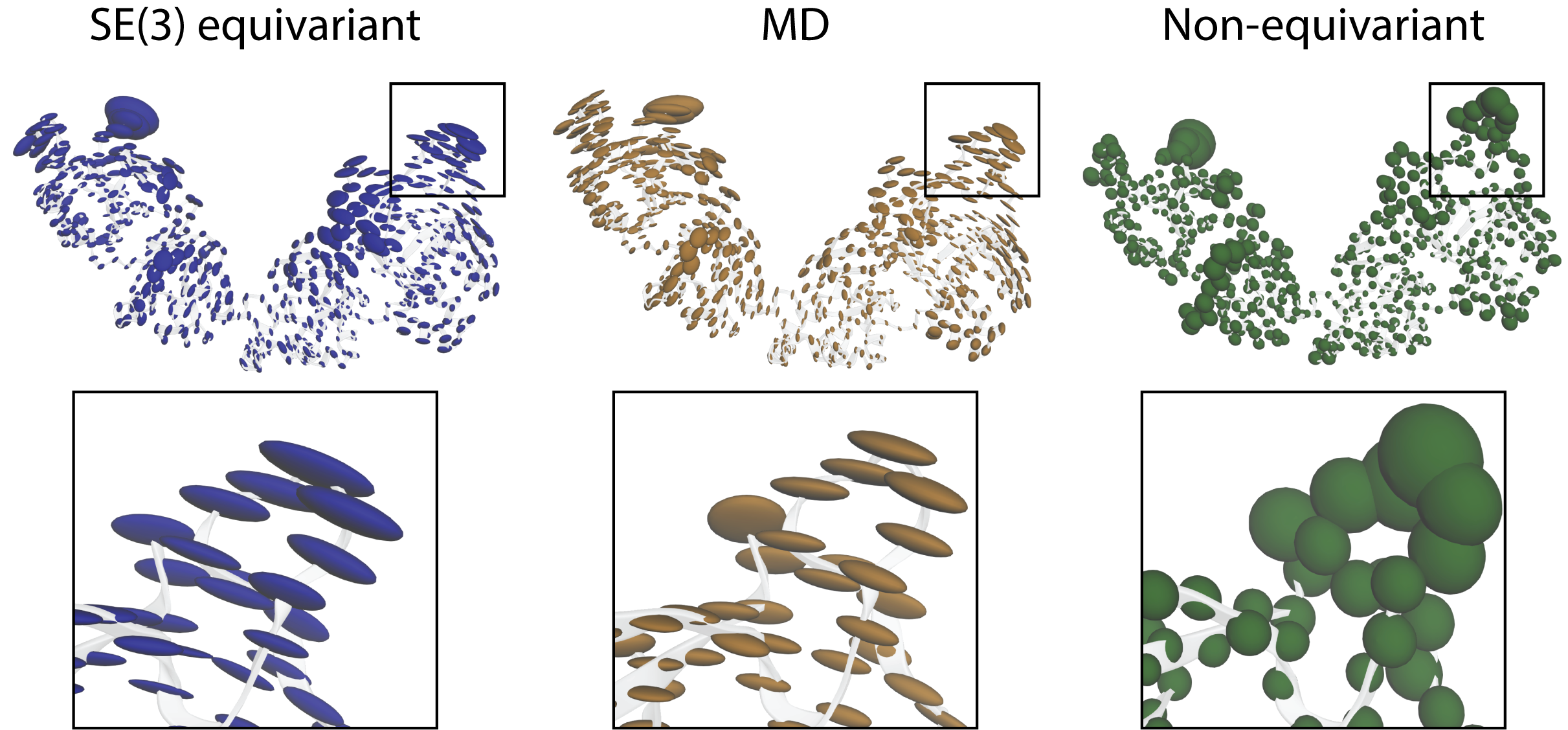
Official BackFlip repository asset corresponding to the paper’s directional-covariance comparison. Source: BackFlip repository asset, paper: arXiv:2609.08474. The project repository is MIT-licensed and the paper is CC BY 4.0. No scientific content was modified.

볼 것: MD에서 관찰되는 residue fluctuation은 대체로 spherical하지 않습니다. Equivariant model은 길쭉한 ellipsoid의 orientation까지 따라가지만, non-equivariant head는 방향을 안정적으로 정의할 수 없어 훨씬 isotropic한 prediction으로 수렴합니다.
이 그림이 지지하는 것은 equivariance가 멋있다는 일반론이 아닙니다. target 자체가 coordinate-frame-dependent tensor라면 output transformation law를 architecture에 넣는 것이 정보 보존에 직접 필요하다는 주장입니다.
Figure B — 한 구조에서 RMSF와 long-range coupling을 동시에 얻는다
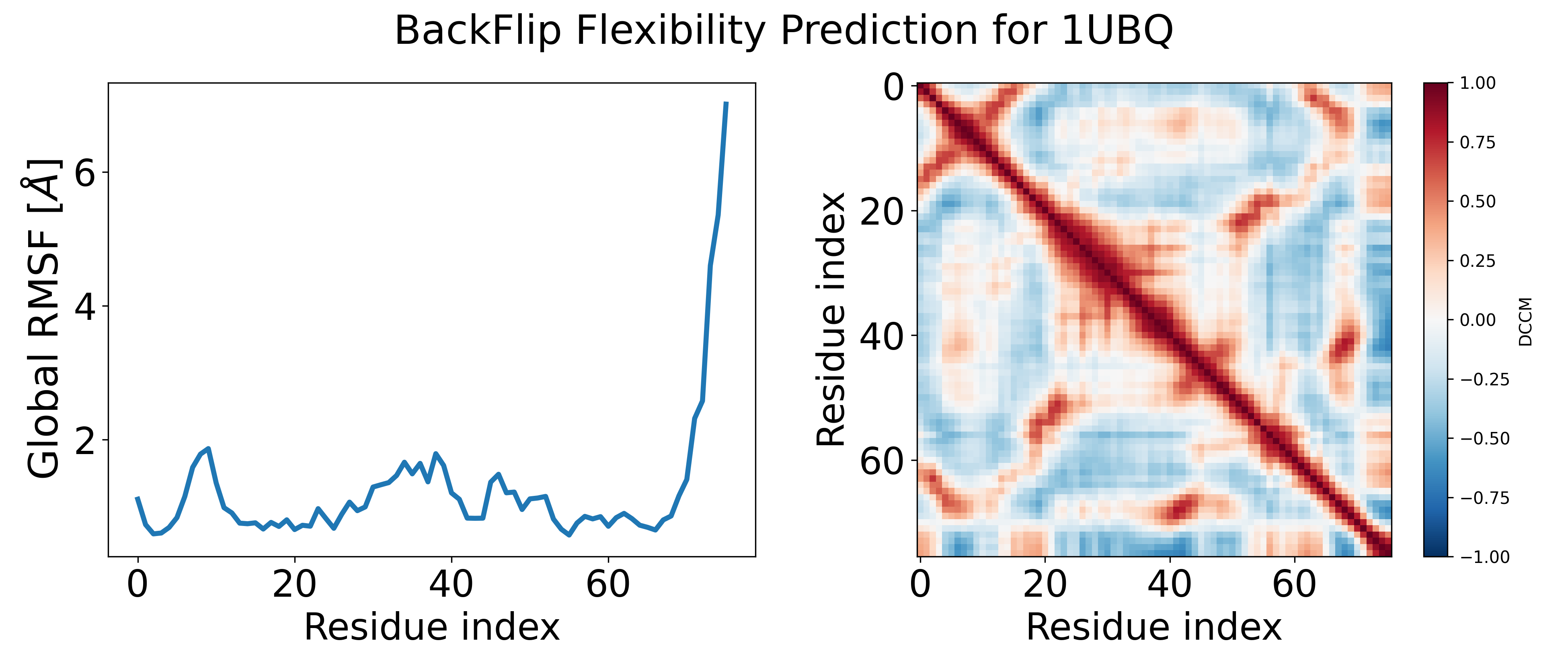
Official BackFlip repository inference example for ubiquitin (1UBQ). Source: BackFlip repository asset. The upper profile is RMSF derived from the predicted covariance; the matrix is the predicted DCCM. Author-produced visualization, not independent validation.

볼 것: RMSF는 diagonal/local flexibility만 보여주지만 DCCM은 residue pair의 correlated and anticorrelated motion을 보여줍니다. BackFlip-2는 이 둘을 별도의 expensive trajectory generation 없이 동일한 structure-conditioned encoder에서 예측합니다.
논문의 adenylate kinase functional example도 중요합니다. Apo structure에서 LID/NMP-binding domain의 covariance direction과 negative inter-domain coupling이 open→closed motion과 관련된 축을 포착한다고 저자들은 해석합니다. 해당 비교는 paper Figure 3에서 보는 것이 가장 정확합니다: paper PDF.
1. Problem: flexibility를 scalar 하나로 줄이면 무엇을 잃는가
MD trajectory에서 residue 의 mean-centered displacement를
라고 하면 가장 기본적인 second moment는
입니다.
이 matrix는 세 가지를 동시에 포함합니다.
- total amplitude,
- anisotropy,
- principal motion direction.
RMSF는
이므로 total amplitude만 남깁니다. 두 residue가 RMSF는 같아도 하나는 hinge 방향으로 길게 움직이고 다른 하나는 isotropic하게 흔들릴 수 있습니다.
Protein function이나 pocket adaptation에서는 이 차이가 중요할 수 있습니다. 특히 ligand approach direction, loop opening, domain closure처럼 특정 direction이 필요한 경우 scalar flexibility만으로는 geometry를 충분히 표현하지 못합니다.
BackFlip-2의 첫 번째 연구 질문은 따라서 단순합니다.
정적 구조 하나에서 residue별 covariance tensor를 직접 예측할 수 있는가?
두 번째 질문은 더 어렵습니다.
trajectory 없이 residue-residue dynamic coupling까지 복원할 수 있는가?
2. Output contract: local tensor와 pairwise scalar를 분리한다
2.1 Per-residue covariance
Residue 에 대해 target은
입니다. 즉 symmetric positive-semidefinite (SPSD) matrix입니다.
좌표를 로 회전하면
이것은 invariant scalar target이 아닙니다. Tensor target의 orientation도 prediction의 일부입니다.
2.2 Pairwise coupling
Full cross-covariance 를 그대로 예측하는 대신 paper는 pairwise scalar coupling을
형태로 다룹니다.
그리고 normalized form인 DCCM은
로 계산합니다.
이 값은 대략 범위에서
- positive: correlated motion,
- negative: anticorrelated motion,
- near zero: weak linear coupling
을 나타냅니다.
여기서 설계가 깔끔합니다.
- direction이 본질적인 per-residue motion → equivariant matrix,
- pair relation의 signed strength → invariant scalar.
Target의 transformation law에 맞춰 output type을 분리한 것이 architecture의 핵심입니다.
3. Input representation: protein backbone을 residue frames로 본다
BackFlip-2는 protein backbone을 residue-wise rigid frame으로 표현합니다.
where
- is a residue position,
- is the residue-local orientation.
Encoder는 modified AlphaFold2 Invariant Point Attention(IPA)을 사용합니다. Paper가 기술하는 main setting은 대략
- node dimension 96,
- pair/edge dimension 64,
- 4 IPA layers,
- backbone frame,
- one-hot amino-acid type,
- positional encoding,
- pair distance features up to 20 Å
입니다.
중요한 점은 backbone frames가 structure generation처럼 update되지 않는다는 것입니다. 여기서는 이미 주어진 equilibrium structure를 읽고 dynamics descriptor를 예측합니다.
따라서 task는
입니다.
4. Covariance head: SPSD와 equivariance를 동시에 보장한다
이 paper에서 가장 재사용 가치가 높은 부분입니다.
Encoder가 residue-local invariant/equivariant representation을 만든 뒤 covariance head는 local frame에서 임의의 matrix 를 예측합니다.
그 다음
로 둡니다.
이 구성은 자동으로
을 만족합니다.
마지막으로 residue frame orientation을 이용해 global coordinate로 보냅니다.
Global protein rotation 를 적용하면 local covariance는 그대로이고 residue frame이 가 되므로
즉 output equivariance가 구조적으로 보장됩니다.
이 방식은 higher-order irrep network를 반드시 깊게 쌓아야 tensor를 예측할 수 있다는 것과는 다릅니다. Local invariant prediction + known frame transport로 physically valid tensor output을 만들 수 있습니다.
5. Pairwise coupling head
Coupling head는 pair embedding을 읽어 scalar 를 예측합니다. Pairwise coupling은 residue ordering을 바꿔도 대칭이어야 하므로 prediction을 symmetrize합니다.
이후 predicted covariance에서 얻은 RMSF와 coupling으로 DCCM을 구성할 수 있습니다.
Representation 관점에서 특히 흥미로운 것은 node tensor + dense pair scalar의 조합입니다.
정적 protein model에 가져오면 다음과 같은 feature contract를 만들 수 있습니다.
residue node:
  static geometry
  amino-acid identity
  covariance tensor / derived invariants

residue pair:
  distance/orientation
  predicted dynamic coupling
  predicted DCCM
이 구조는 protein-ligand pairformer류 모델에서 dynamics를 별도의 pair channel로 넣는 아이디어와 자연스럽게 연결됩니다.
6. Training objective
Paper는 covariance matrix 자체의 discrepancy, scalar amplitude, pair coupling을 하나로 묶어 학습합니다.
핵심 supervision은 대략 다음 세 층입니다.
- covariance geometry,
- RMSF / magnitude,
- DCCM / coupling.
Covariance comparison에는 covariance-matrix distance(CMD) 계열을 사용하고, RMSF MAE와 DCCM MSE를 함께 최적화합니다.
이 multi-objective가 필요한 이유는 matrix loss 하나만으로는 downstream에서 읽기 쉬운 amplitude와 pair correlation 품질을 충분히 통제하지 못할 수 있기 때문입니다.
Paper의 main model은 200 epochs 학습되고, 저자들은 single A100에서 약 4 GPU-hours 수준의 training cost를 보고합니다. Checkpoint selection은 validation loss 기준입니다.
7. Data contract: 무엇을 ground truth dynamics로 보는가
ATLAS
ATLAS setting은 paper의 주요 training/evaluation source입니다.
저자 설명 기준:
- 1,390 proteins,
- protein당 3 independent trajectories,
- trajectory당 100 ns,
- CHARMM36m,
- 300 K,
- 2 fs timestep.
Trajectory에서 residue covariance와 cross-residue coupling을 계산해 supervised labels로 사용합니다.
mdCATH
mdCATH는 domain-level MD collection으로 cross-dataset transfer를 보는 데 사용됩니다.
Paper는
- 5,398 domains,
- multiple temperatures,
- 320 K subset을 주요 comparison에 사용,
- total 500 ns-scale trajectories,
- CHARMM22,
- 4 fs timestep
이라는 protocol 차이를 다룹니다.
이 차이는 단순 dataset shift가 아닙니다. Force field, temperature, timestep, domain composition, simulation protocol이 모두 달라질 수 있습니다.
따라서 BackFlip-2가 배우는 target을 더 정확하게 쓰면
protein의 절대적이고 유일한 dynamics
가 아니라
특정 MD protocol과 sub-microsecond observation window에서 정의된 second-order fluctuation statistics
입니다.
이 distinction은 downstream application에서 반드시 유지해야 합니다.
8. Evaluation: 하나의 metric으로 tensor prediction을 판단하면 안 된다
Paper는 flexibility를 여러 axis로 나눠 평가합니다.
| Metric | 무엇을 본다 |
|---|---|
| RMSF Pearson | residue-wise amplitude ranking |
| RMSF MAE | absolute amplitude error |
| RMWD | covariance matrix geometry discrepancy |
| symmetric KL | Gaussian covariance distribution mismatch |
| ellipsoid IoU / Dice | anisotropic shape + orientation overlap |
| DCCM Pearson | pair coupling pattern |
| DCCM MAE | pair coupling absolute error |
특히 ellipsoid overlap이 중요합니다. RMSF가 비슷한 두 covariance라도 principal axis가 다르면 directional dynamics prediction은 틀릴 수 있습니다.
9. Main result 1: cheap RMSF surrogate를 넘어선다
저자 보고 ATLAS FlexPert split에서 대표 결과는 다음과 같습니다.
| Method | RMSF Pearson ↑ | RMSF MAE ↓ | Params | Inference |
|---|---|---|---|---|
| MD reference trajectory-vs-trajectory | 0.88 | 0.47 | — | s-scale |
| FlexPert | 0.83 | 0.80 | 1.2B | ~0.4 s |
| Pegasus | 0.75 | 0.82 | 11M | ~2.5 s |
| BackFlip | 0.84 | 0.62 | 321K | ≤0.02 s |
| BackFlip-2 | 0.87 | 0.58 | 965K | ≤0.02 s |
이 결과의 올바른 읽기는 BackFlip-2가 MD를 대체했다가 아닙니다.
MD trajectory 두 개 사이에도 finite-sampling discrepancy가 존재하고, BackFlip-2는 MD-derived descriptors를 빠르게 근사합니다. 즉 trajectory-level microstates를 생성하는 대신 second-order summary statistics를 amortize한 것입니다.
De novo protein subset에서도 저자들은 BackFlip-2가 기존 cheap predictors보다 더 높은 RMSF agreement를 보고합니다. 이 결과는 training-set memorization만으로 설명하기 어려운 signal을 주지만, de novo set 하나가 모든 structural OOD를 보장하는 것은 아닙니다.
10. Main result 2: ensemble model과 비교하면 trade-off가 보인다
AlphaFlow-style split에서 paper가 보고한 대표 값은 다음과 같습니다.
| Method | RMWD ↓ | Sym. KL ↓ | RMSF r ↑ | RMSF MAE ↓ | DCCM r ↑ | DCCM MAE ↓ | Inference |
|---|---|---|---|---|---|---|---|
| BackFlip-2 | 0.88 | 0.67 | 0.89 | 0.35 | 0.80 | 0.16 | ≤0.02 s |
| AFMD-T | 0.84 | 0.60 | 0.93 | 0.25 | 0.89 | 0.12 | ~8,200 s |
| BBFlow | 0.93 | 0.65 | 0.93 | 0.42 | 0.86 | 0.16 | ~160 s |
| DynaProt | 1.18 | 0.91 | 0.87 | — | 0.66 | — | ~0.02 s |
BackFlip-2는 covariance quality에서 훨씬 비싼 ensemble methods와 경쟁력이 있지만, DCCM coupling은 AFMD-T/BBFlow보다 약합니다.
이 trade-off가 중요합니다.
- 필요한 것이 cheap annotation이라면 BackFlip-2의 속도 이점이 큽니다.
- alternative conformations나 long-range coupling accuracy가 핵심이면 ensemble generation이 여전히 더 많은 정보를 제공합니다.
즉 fast dynamics surrogate와 full ensemble generator는 같은 product가 아닙니다.
11. Equivariance ablation: 왜 방향성 target에는 symmetry가 실제로 필요한가
Paper의 directional ellipsoid overlap에서 저자 보고값은 대략 다음과 같습니다.
| Model | IoU ↑ | Dice ↑ |
|---|---|---|
| BackFlip-2 equivariant | 0.49 | 0.64 |
| non-equivariant variant | 0.42 | 0.58 |
| BioEmu | 0.25 | 0.38 |
| AFMD-T | 0.48 | 0.63 |
| BBFlow | 0.47 | 0.62 |
Non-equivariant model은 RMSF amplitude는 어느 정도 맞출 수 있어도 covariance ellipsoid가 near-spherical해지는 경향을 보입니다.
왜 그런지 생각하면 자연스럽습니다. Global frame에서 arbitrary direction을 예측하게 하면 protein을 회전시켰을 때 prediction direction이 어떻게 바뀌어야 하는지 학습으로만 알아내야 합니다. Equivariant head는 그 constraint를 architecture에 고정합니다.
이 논문이 주는 일반 원칙은:
Invariant scalar benchmark만 보고 equivariant architecture의 가치를 판단하면 방향성 information gain을 놓칠 수 있다.
입니다.
12. PSD parameterization ablation: 복잡한 Cholesky가 꼭 낫지는 않다
Appendix ablation은 covariance parameterization과 equivariance를 분리합니다.
대표적으로 저자들이 보고한 패턴은:
- equivariant + simple : best/near-best overall,
- equivariant + Cholesky: 비슷하지만 명확한 우위 없음,
- non-equivariant variants: covariance geometry와 DCCM에서 더 큰 손실.
즉 improvement의 핵심은 더 정교한 SPD parameterization보다 올바른 transformation law에 있습니다.
이것은 implementation lesson으로 꽤 좋습니다. 물리 constraint를 넣을 때 가장 복잡한 parameterization부터 시작할 필요가 없습니다.
13. Cross-dataset transfer: mdCATH가 보여주는 것
ATLAS-trained model을 mdCATH 320 K subset에 그대로 적용하면 저자들은 대략
- RMWD 1.63,
- symmetric KL 2.57,
- RMSF Pearson 0.85,
- RMSF MAE 0.69,
- DCCM Pearson 0.81,
- DCCM MAE 0.15
를 보고합니다.
Joint ATLAS+mdCATH training은 mdCATH covariance metrics를 개선해 대략 RMWD 1.51, KL 1.72 수준으로 낮추지만 ATLAS에서 일부 metric은 약간 희생합니다.
이 결과는 중요한 경고를 줍니다.
따라서 dynamics foundation feature를 만들려면 dataset을 그냥 합치는 것보다 condition/domain metadata를 명시적으로 모델링할 가능성을 고려해야 합니다.
14. Input robustness: perfect crystal geometry만 요구하지 않는다
Paper appendix는 input coordinate perturbation과 AlphaFold-predicted structure를 사용한 robustness test를 제공합니다.
저자 보고상
- 0.2 Å noise,
- 0.5 Å noise,
- AlphaFold structure input
에서도 main metrics가 급격히 붕괴하지 않습니다. AlphaFold input의 median global RMSD가 수 Å 수준이어도 RMSF/covariance metrics가 상당 부분 유지됩니다.
이것은 실제 application에서 중요합니다. Dynamics annotation이 experimental structure에만 묶이면 large-scale proteome annotation에 쓰기 어렵기 때문입니다.
하지만 이것도 predicted structure에서 pocket dynamics가 정확하다는 뜻은 아닙니다. Global robustness와 local binding-site accuracy는 별도의 test가 필요합니다.
15. Functional examples: adenylate kinase를 어떻게 읽어야 하는가
Adenylate kinase는 open apo state와 closed holo state 사이에 큰 domain motion이 있는 classical example입니다.
저자들은 apo structure에서
- LID / NMP-binding regions가 상대적으로 flexible하고,
- covariance ellipsoid의 principal directions가 closure/opening axis와 관련되며,
- domains 사이에 anticorrelated coupling pattern이 나타나는 것
을 보여줍니다.
이것은 BackFlip-2가 단순 B-factor-like amplitude만 배우는 것이 아니라 functionally interpretable direction/coupling signal을 포착할 수 있다는 qualitative evidence입니다.
하지만 다음까지는 증명하지 않습니다.
Second moment는 transition path나 multimodal free-energy landscape 전체가 아닙니다.
16. 가장 중요한 limitation: Gaussian second moment와 sub-microsecond timescale
Covariance는 본질적으로 분포를 second-order moment로 압축합니다.
한 basin 안의 near-Gaussian fluctuation에는 좋은 descriptor일 수 있지만,
state A ←→ high barrier ←→ state B처럼 distinct metastable state가 있는 경우 하나의 covariance matrix는 두 state의 구조와 barrier를 표현하지 못합니다.
Paper 자체도 descriptor가 주로 300–500 ns 이하 MD regime에 맞춰져 있으며 millisecond-scale transition이나 strongly multimodal dynamics에는 ensemble/sampling model이 더 적합하다는 boundary를 둡니다.
따라서 BackFlip-2를 다음과 혼동하면 안 됩니다.
- MD simulator,
- conformational ensemble generator,
- free-energy estimator,
- transition-path sampler.
BackFlip-2는 fast dynamics descriptor predictor입니다.
17. SBDD에서 어디에 써볼 수 있는가
가장 자연스러운 사용은 docking model을 BackFlip-2로 교체하는 것이 아니라 protein representation에 side-channel을 추가하는 것입니다.
17.1 Residue node feature
Covariance에서 invariant descriptor를 뽑을 수 있습니다.
이들은 flexibility magnitude와 anisotropy를 scalar node feature로 제공합니다.
17.2 Equivariant directional feature
Principal eigenvector를 쓰고 싶다면 global Cartesian vector를 scalar MLP에 그대로 넣으면 안 됩니다. Downstream model이 equivariant하다면
를 proper vector/tensor channel로 전달하거나 residue-local frame으로 표현해야 합니다.
즉 BackFlip-2 feature를 사용할 때도 coordinate contract를 유지해야 합니다.
17.3 Pair feature
DCCM은 pairformer-style representation과 특히 잘 맞습니다.
Static distance/contact와 별개로 tend to move together / against each other를 pair channel에 추가할 수 있습니다.
17.4 Pocket mobility prior
Pocket residue의 covariance principal axis가 cavity opening direction과 관련된다면 ligand placement/refinement에서 useful prior가 될 가능성이 있습니다.
하지만 이것은 아직 hypothesis입니다. Paper에는 protein-ligand pose/affinity experiment가 없습니다.
18. 내가 먼저 돌릴 matched ablation
BackFlip-2의 SBDD utility를 확인하려면 복잡하게 시작할 필요가 없습니다.
Arms
| Arm | Protein dynamics feature |
|---|---|
| A | static structure only |
| B | + predicted scalar RMSF |
| C | + covariance eigenvalues / anisotropy invariants |
| D | + full equivariant covariance representation |
| E | + DCCM pair channel |
| F | + covariance + DCCM |
Evaluation
동일 model capacity와 training budget에서 최소한 다음을 분리해 봅니다.
- pose top-1 / top-k,
- pocket-conditioned ranking or scoring,
- apo→holo robustness,
- protein-family OOD,
- pocket-similarity OOD,
- flexible-loop subset,
- rigid-pocket subset,
- inference overhead,
- cached-feature storage cost.
가장 중요한 control
MD-derived true descriptors를 teacher/oracle로 둔 upper-bound arm을 추가해야 합니다.
static
vs predicted BackFlip-2 dynamics
vs MD-derived dynamics
Predicted dynamics가 도움이 안 된다면 두 가능성을 나눌 수 있습니다.
- dynamics feature 자체가 task에 불필요하다.
- useful하지만 predictor error가 information을 지운다.
이 구분 없이 BackFlip-2 feature failed라고 결론 내리면 안 됩니다.
19. 더 강한 test: apo/holo와 pocket-specific directionality
특히 SBDD에서는 global protein metric보다 pocket-local test가 더 중요합니다.
다음 protocol이 더 직접적입니다.
- apo structure만 input으로 사용.
- BackFlip-2 covariance를 예측.
- holo ligand가 들어오면서 실제로 이동한 pocket residues의 displacement를 계산.
- predicted principal covariance axis와 apo→holo displacement angle을 비교.
예를 들어
를 볼 수 있습니다.
여기서 는 predicted dominant fluctuation axis입니다.
이 metric이 random-axis / RMSF-only baseline보다 높다면 directional flexibility가 실제 pocket adaptation direction에 information을 준다는 더 직접적인 evidence가 됩니다.
주의할 점은 holo structure나 ligand pose에서 derived된 정보를 input preprocessing에 섞지 않는 것입니다. 그렇지 않으면 coordinate/template leakage가 생깁니다.
20. Reproducibility path
공식 repository는 비교적 좋은 reproduction surface를 제공합니다.
Released artifacts
- BackFlip-2.1 ATLAS checkpoint,
- mdCATH checkpoint,
- joint ATLAS+mdCATH checkpoint,
- dataset preparation files,
- modified ATLAS features,
- inference API / CLI,
- covariance/DCCM evaluation script,
- explicit equivariance test script,
- Colab tutorial.
공식 Python API는 한 PDB에서
per_res_covariance,pairwise_couplings,pairwise_DCCM
을 반환합니다.
Repository는 batched A100 inference에서 약 50 proteins/s까지 가능하다고 기술하지만, 이 throughput은 hardware, length distribution, batching에 의존하는 repository-reported figure로 봐야 합니다.
Dataset license caveat
Software는 MIT지만 modified ATLAS dataset은 upstream 조건에 따라 CC BY-NC 4.0으로 안내됩니다. 따라서 code license와 dataset license를 분리해 봐야 합니다.
21. What the paper establishes
이 paper의 evidence가 비교적 강하게 지지하는 것은 다음입니다.
- Static equilibrium structure에서 MD-derived RMSF를 상당히 정확하게 amortize할 수 있습니다.
- Scalar RMSF를 넘어 anisotropic per-residue covariance를 직접 예측할 수 있습니다.
- Equivariant output construction이 directional covariance quality를 개선합니다.
- Pairwise DCCM pattern도 cheap하게 예측할 수 있습니다.
- ATLAS→mdCATH transfer와 coordinate perturbation/AF input robustness에서 일정 수준의 generalization signal이 있습니다.
- Full ensemble methods보다 정보는 제한적이지만 inference cost가 극도로 낮습니다.
22. What the paper does NOT establish
다음 claim은 아직 별도 검증이 필요합니다.
Ligand binding utility
Protein dynamics descriptor accuracy가 좋아도
Paper에는 이 downstream evidence가 없습니다.
Long-timescale transitions
Single covariance와 DCCM은 multimodal landscape와 rare transition kinetics를 복원하지 않습니다.
Experimental dynamics equivalence
Ground truth의 중심은 MD-derived observable입니다. NMR/order parameters/HDX/B-factor와의 관계는 별도 measurement model이 필요합니다.
Universal dynamics across simulation protocols
ATLAS와 mdCATH 차이 자체가 보여주듯 force field, temperature, simulation length가 target distribution에 영향을 줄 수 있습니다.
Pocket-local OOD
Global protein metric이 유지되어도 flexible loop, cryptic pocket, membrane protein, intrinsically disordered region 같은 difficult regime에서 동일하다고 말할 수 없습니다.
23. Failure modes
| Failure mode | 왜 위험한가 |
|---|---|
| RMSF 성능만 보고 directional model을 평가 | anisotropy와 orientation information을 못 봄 |
| DCCM을 causal allostery로 해석 | correlation은 causation/energy pathway가 아님 |
| covariance를 conformational ensemble로 해석 | second moment는 multimodal states를 복원하지 못함 |
| one MD protocol을 biological truth로 취급 | force field/timescale/temperature dependence 무시 |
| principal vector를 scalar network에 그대로 넣음 | rotation-frame leakage / broken transformation contract |
| holo ligand-derived alignment을 apo input feature로 사용 | deployment-unavailable information leakage |
| protein-level split만 보고 pocket OOD 주장 | local site similarity leakage 가능 |
| fast throughput만 보고 ensemble method와 동일 product로 비교 | output information content가 다름 |
24. 가장 중요한 architecture lesson
이 논문을 6개월 뒤에도 기억할 이유는 BackFlip이라는 이름보다 다음 설계 원칙입니다.
24.1 Target symmetry를 먼저 정의한다
Output이 scalar인지 vector인지 tensor인지 먼저 정합니다.
24.2 Physical validity를 parameterization으로 보장한다
만으로 covariance의 SPSD constraint를 만족시킵니다.
24.3 Local frame에서 예측하고 known transform으로 globalize한다
복잡한 tensor network 없이도
으로 exact equivariance를 만들 수 있습니다.
24.4 Expensive process의 모든 microstate를 생성하지 않아도 된다
Downstream에 필요한 것이 descriptor라면
가 훨씬 효율적일 수 있습니다.
이 마지막 원칙은 MD뿐 아니라 docking ensembles, conformer ensembles, perturbation response에서도 반복해서 쓸 수 있습니다.
25. Final verdict
Verdict: Must Read for protein representation / geometric learning; promising but unproven as an SBDD dynamics feature.
BackFlip-2의 가장 좋은 점은 MD를 AI로 대체했다는 과장된 framing이 아니라, 어떤 dynamics information을 cheap surrogate로 만들 것인지 output space를 명확하게 선택했다는 것입니다.
RMSF 하나가 아니라 covariance tensor와 DCCM을 예측함으로써
을 분리합니다.
그리고 covariance를 residue-local frame에서 SPSD로 만든 뒤 global frame으로 transport하는 head는 다른 geometric prediction task에도 재사용하기 좋은 pattern입니다.
SBDD 관점에서는 당장 main docking architecture에 넣기보다 cached protein-side dynamics annotation으로 실험하는 것이 가장 합리적입니다. 먼저 scalar RMSF → anisotropy invariants → full covariance → DCCM 순서의 matched ablation을 하고, MD-derived descriptor upper bound와 apo/holo pocket-direction test를 같이 두는 것이 좋습니다.
6개월 뒤 기억해야 할 세 가지
- RMSF는 covariance의 trace일 뿐이다. BackFlip-2의 핵심은 amplitude뿐 아니라 anisotropic direction과 residue-pair coupling을 static structure에서 예측하는 것입니다.
- Equivariance는 이 task에서 decoration이 아니다. Tensor target이 회전에 따라 변해야 하므로 local covariance를 global frame으로 transport하는 transformation contract가 directional accuracy를 직접 좌우합니다.
- 이 모델은 ensemble generator가 아니라 descriptor surrogate다. Sub-microsecond/Gaussian second-order dynamics에는 매우 빠르고 유용할 수 있지만, rare transitions, multimodal states, ligand binding utility는 별도 evidence가 필요합니다.
Related Notes
Sources
- Viliuga V. et al., Predicting directional flexibility in proteins, arXiv:2609.08474 — https://arxiv.org/abs/2609.08474
- Official BackFlip repository — https://github.com/graeter-group/backflip
- BackFlip repository snapshot inspected for this note — https://github.com/graeter-group/backflip/tree/887c6a73b216e3fe2ff9f551ae6e2c983c21b292
- ATLAS / mdCATH dataset and checkpoint instructions — official BackFlip README
- Paper license — CC BY 4.0 as declared by arXiv